

In Singapore’s highly regulated financial ecosystem, the collapse of Tokenize Xchange, operated by AmazingTech Pte Ltd (ATPL), illustrates how swiftly purported deficiencies in governance and compliance can trigger regulatory intervention and potentially result in criminal proceedings. This case, widely reported across regional media, has become another example underlining the importance of appropriate safeguarding and segregation of client assets.
Chronology of Events
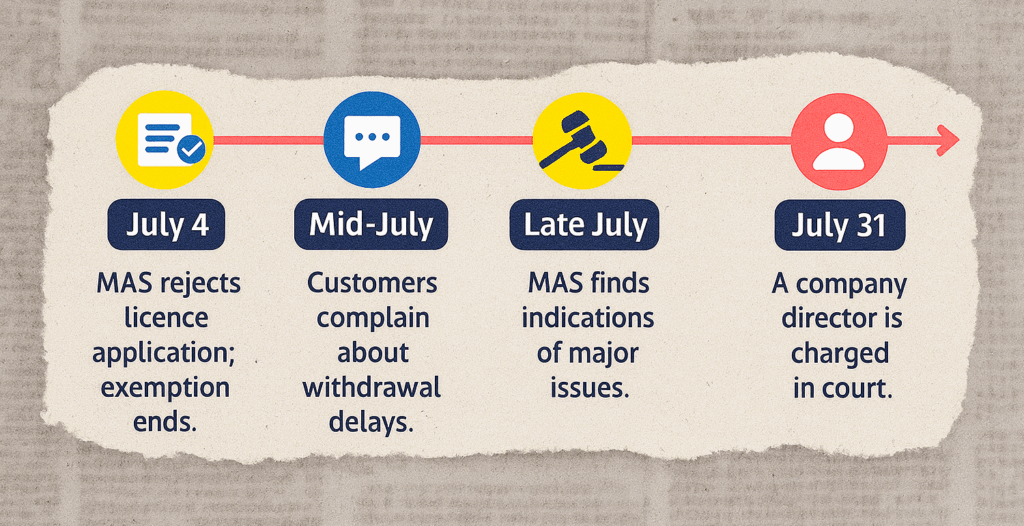
The Timeline: From License Denial to Criminal Investigations
1. Operating Under an Exemption
ATPL, running Tokenize Xchange here in Singapore, initially operated under a temporary exemption under the Payment Services Act 2019 (PSA), while awaiting a decision on its Major Payment Institution (MPI) licence application.
2. License Rejection and Wind‑Down Directive
On 4 July 2025, Monetary Authority of Singapore (MAS) rejected ATPL’s licence application, and directed ATPL to cease operations, conduct an orderly wind-down and ensure the prompt return of all customer monies and digital payment tokens. (Source: Channel NewsAsia, 1 Aug 2025)
3. Customer Complaints and Asset Shortfall Revelations
By mid‑July 2025, customer complaints surfaced regarding withdrawal delays. MAS intervened and instructed ATPL to rectify these issues, including replenishing any shortfalls in customer accounts. Through ongoing engagements, MAS discovered that ATPL likely lacked sufficient assets to fulfil customer claims, potentially failed to segregate customer assets from its own funds, and may have made false statements regarding this segregation during its license application process. (Source: Fintech News Singapore, 4 Aug 2025)
4. Referral to Commercial Affairs Department (CAD)
Given the serious nature of these findings, MAS referred the matter to the Commercial Affairs Department (CAD) of the Singapore Police Force. On 31 July 2025, Hong Qi Yu, a director of ATPL, was charged in court under Section 238(4) of the Insolvency, Restructuring and Dissolution Act 2018 in relation to alleged fraudulent trading, an offence that carries penalties of up to seven years’ imprisonment, a significant fine, or both. (Source: Hubbis, 4 Aug 2025)
5. Operational Wind‑Down, Relocation, and Judicial Oversight
Tokenize Xchange has announced plans to exit Singapore by 30 September 2025, reportedly laying off all 15 Singapore-based staff, with optimism about continuing operations in offshore jurisdictions such as Labuan (Malaysia) and seeking approval in the Abu Dhabi Global Market (ADGM) territory. Simultaneously, MAS has been closely monitoring ATPL’s progress in returning customer assets via phased withdrawal tiers, based on portfolio sizes, with final completion mandated by 30 September. Source: (Source: Channel NewsAsia, 25 Jul 2025)
6. Investors Petition the Court
In early August, at least seven investors petitioned the High Court to place ATPL under interim judicial management, citing alleged withdrawal failures involving more than S$4 million (approx. USD 3 million). Another law firm also began organising a class action involving over 100 affected investors with claims of around S$40 million. (Source: Straits Times via Singapore Law Watch, 7 Aug 2025)
7. Court Appoints Interim Judicial Managers
On 15 August 2025, the High Court approved the petition and appointed interim judicial managers from KordaMentha to assume control of ATPL’s operations. Their mandate is to safeguard creditors’ interests and explore potential recovery options for affected investors. (Source: Channel NewsAsia, 15 Aug 2025)
Asset Segregation: A Foundational Control
MAS has long emphasised safeguarding of customer assets as a fundamental regulatory requirement. S.16 of the Payment Services Regulations specifically details the need for segregation of funds. Furthermore under PSn07 it is further elaborated that licensees are required to:
- Segregate customer monies and digital tokens appropriately using safeguarding institutions (where relevant).
- Ensure safeguarding arrangements are legally enforceable and insulated from creditor claims.
- Undertake daily reconciliation to confirm adequacy of safeguarded assets.
The principle is not unique to payment services alone. Across Singapore’s broader financial regulatory landscape, MAS has consistently emphasized that client assets must be ring-fenced from institutional risk. For instance, while fund managers operate under a distinct regulatory regime, they too are subject to requirements that ensure client assets are segregated and protected through independent custody arrangements (para 4.1.1 of the Guidelines on Licensing and Conduct of Business for Fund Management Companies).
In both contexts, the common denominator is clear: client monies must not be commingled with the firm’s own proprietary funds. Segregation is not merely a procedural formality. It represents both a fiduciary duty to clients and a critical safeguard for market integrity. How does anyone participate in the markets if the moment their funds deposited with a financial institution does not belong to them – in title- anymore?
Why the Case Resonates Across the Industry
The Tokenize Xchange episode is a cautionary benchmark in MAS’s enforcement trajectory. It:
- treats purported breaches of safeguarding obligations as structural governance failures, not mere operational lapses.
- shows that enforcement action, once commenced, can rapidly escalate from supervisory measures to criminal prosecution.
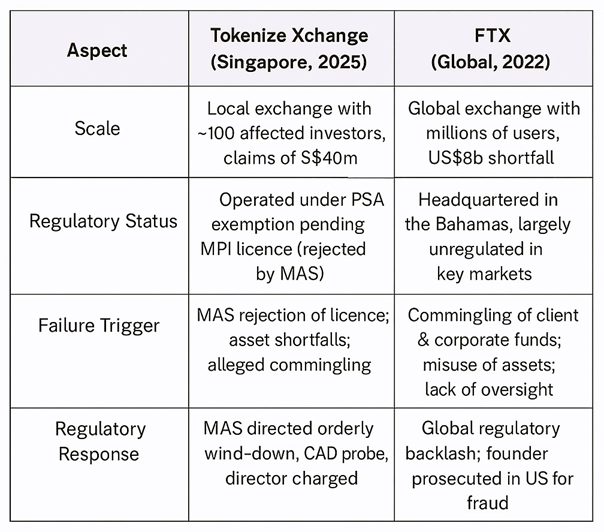
Sadly, if true – Tokenize is not an isolated case. The collapse of FTX in November 2022 sent shockwaves through financial markets worldwide as it exposed how quickly market confidence can evaporate when clients’ assets are misused. FTX once valued at over USD 32 billion, imploded within days following revelations of widespread commingling of client funds with proprietary trading losses at its affiliate Alameda Research, resulting in bankruptcy filings, criminal charges against founder Sam Bankman-Fried, and over USD 8 billion in customer losses. (Source: BBC, 8 May 2024; Investopedia, 10 Oct 2024).
The FTX fiasco set a new global regulatory baseline: failures of this scale must never reoccur. Yet, the fact that similar weaknesses have apparently resurfaced at Tokenize explains the regulators’ swift and firm action thereafter.
Comparison: Tokenize Xchange vs FTX
Lessons for Financial Institutions
The parallel between FTX and Tokenize offers a stark reminder for all financial institutions. In the aftermath of the FTX collapse, regulators worldwide decisively tightened scrutiny on asset segregation and governance.
In response, on 26 October 2022, MAS proposed measures to enhance consumer protection by strengthening safeguards for cryptocurrency trading and stablecoins, underlining the urgent need for more rigorous risk management and governance frameworks.
Fund managers, fintech operators, and payment institutions should note these imperatives:
- Appropriate Safeguarding & Segregation – Customer assets must be maintained separately from proprietary funds utilising appropriate custody safeguarding infrastructure. This must be independently validated, regularly reconciled, and subject to robust audit protocols.
- Governance and Accountability – Boards and senior management bear ultimate responsibility for the mismanagement of customer assets. Failures in this domain will invariably be construed as leadership deficiencies and can likely result in criminal proceedings.
- Supervisory Readiness – Institutions should maintain inspection-ready posture at all times, demonstrating resilience under MAS thematic reviews or targeted inspections, even while under exemption.
The current circumstances, if substantiated, reinforce a cardinal principle of financial regulation in Singapore: client assets are sacrosanct. Safeguarding is the cornerstone of market confidence, not an administrative checkbox.
Why Partner with Curia Regis
At Curia Regis, we closely support regulated financial institutions across the market. Proper segregation of client assets is more than a compliance requirement—it is the foundation of trust that sustains your business.
Our services include:
- Audits of asset segregation and safeguarding arrangements to identify and close compliance gaps.
- Internal control frameworks that withstand MAS inspections and thematic reviews.
- Licensing, governance, and ongoing monitoring support to align with MAS regulations and global best practices.
If you need support translating your requirements into operational safeguards that protect both your clients and your institution, contact us here or email admin@thecuriaregis.com.