

What’s New and Why?
On 29 August 2025, AUSTRAC formally tabled the Anti-Money Laundering and Counter-Terrorism Financing (AML/CTF) Rules 2025 in Parliament, following an extensive two-stage consultation process that garnered 229 industry submissions.
These Rules complement the recently amended AML/CTF Act, providing clearer guidance on regulatory obligations ranging from risk management, governance, enrolment, and reporting. The reforms aimed at strengthening Australia’s anti-financial crime defences and to ensure alignment with evolving global standards of best practice.
Phased Implementation Timeline

The Rules will be introduced in a staggered manner to facilitate a practical transition for affected sectors:
- 31 March 2026: Commencement of enhanced compliance obligations for existing reporting entities, alongside the enrolment opening for newly regulated “Tranche 2” sectors and Virtual Asset Service Providers (VASPs).
- 1 July 2026: Full AML/CTF obligations take effect for Tranche 2 entities including real estate agents, legal practitioners, accountants, trust and company service providers, dealers in precious metals and stones, and virtual asset services.
- 2029: Continuation of existing threshold transaction and suspicious matter reporting requirements, marking a future review point rather than a new compliance milestone.
Who is Affected?
The new AML/CTF Rules will affect you if you are already regulated under AUSTRAC’s regime such as banks, credit unions, remittance providers, superannuation funds, casinos, and bullion dealers. In addition, the reforms extend to previously unregulated ‘Tranche 2’ sectors, including real estate, legal, accounting, trust and company services, precious metals and stones, and virtual assets.
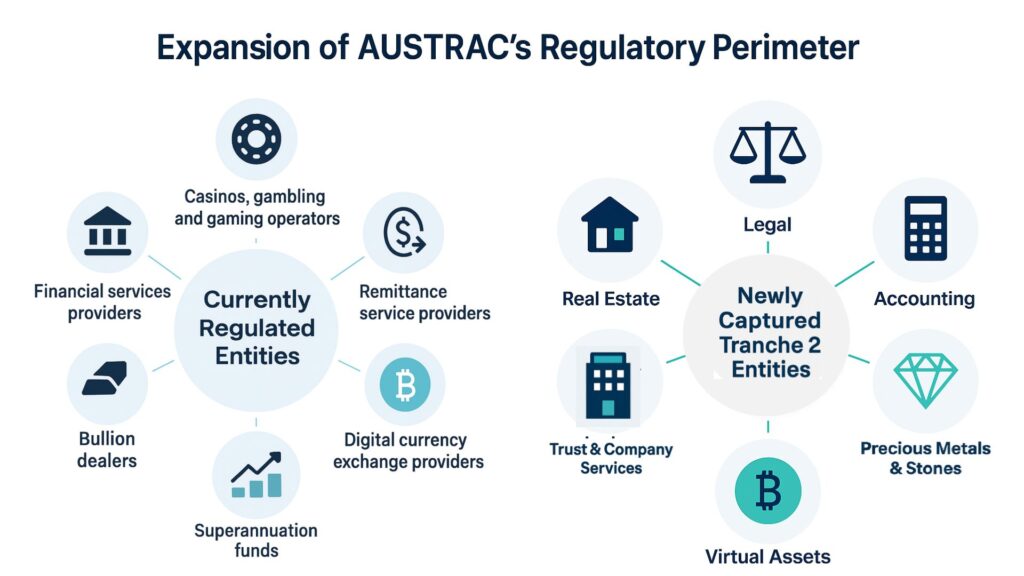
AUSTRAC has also published a “Check if I’ll be regulated” tool on its reform page to help businesses confirm whether they fall within scope. This resource provides a simple way to assess whether your organisation will be captured under the new framework.
Structural Composition of the Rules
The legislative framework comprises two key instruments:
- General Obligations Rules – outlining the core duties aligning with the revised Act.
- Class Exemptions & Other Matters Rules – detailing exemptions and sector-specific provisions, building upon the existing 2007 framework.
To support industry transition, AUSTRAC has also published a renumbering and amendment “ready reckoner”, enabling firms to map changes between drafts and final provisions.
Key Regulatory Enhancements
The AML/CTF Rules 2025 introduce a series of critical enhancements designed to embed a risk-based, outcomes-oriented supervisory approach:
- Risk-Based Compliance: A shift away from prescriptive checklists towards continuous, risk-calibrated assessment of money laundering, terrorism financing, and proliferation financing risks.
- Governance and Accountability: Reinforced board and senior management responsibilities, including the mandatory appointment of an AML/CTF compliance officer.
- Customer Due Diligence (CDD): Enhanced flexibility in applying CDD, balanced with stronger verification requirements.
- Reporting Groups: Simplified frameworks that minimise duplication while improving regulatory transparency within corporate structures.
AUSTRAC’s Expectations & Support
For the 2025–26 period, AUSTRAC has emphasised outcomes-driven implementation, expecting:
- Established entities to maintain robust AML/CTF controls, actively demonstrating progress towards compliance readiness.
- Newly regulated Tranche 2 entities to complete enrolment and registration by 1 July 2026, adopt tailored AML/CTF programs, appoint compliance officers, and establish effective suspicious matter reporting processes.
To ease this transition, AUSTRAC will publish comprehensive core guidance in October 2025 and sector-specific starter kits by December 2025, tailored to Tranche 2 industries’ unique needs.
Compliance Expectations for Tranche 2 Entities
For the first time, AUSTRAC’s AML/CTF framework will extend to professional service providers and high-value sectors historically targeted by illicit finance. This expansion mandates:
- Registration and enrolment with AUSTRAC, inclusive of VASPs under mandatory registration.
- Development and execution of proportionate, sector-specific AML/CTF programs.
- Rigorous CDD processes, including verification of beneficial ownership.
- Timely reporting of suspicious activities and threshold transactions, adhering to AUSTRAC’s standards.
- Retention of comprehensive records, with tailored protections such as legal professional privilege provisions for lawyers.
This expansion brings Australia into closer alignment with international regimes such as the UK and Singapore, where these sectors have long been more comprehensively regulated in comparison.
Why It Matters
The AML/CTF Rules 2025 mark a significant reform of Australia’s fight against financial crime, embedding a risk-based compliance model and extending oversight to critical sectors. Beyond compliance, the reforms reinforce Australia’s credibility on the global stage, strengthens resilience against illicit finance, and prepares the financial system for Financial Action Task Force (FATF)’s upcoming evaluation. Ultimately, the reforms aim to promote Australia as a tier-1 financial centre by instilling market confidence and bolstering national security efforts by disrupting illicit finance more effectively.
How Curia Regis Can Help
Australia’s AML/CTF reforms reflect a broader global shift in financial crime compliance, with regulators worldwide moving toward risk-based, outcomes-driven regulatory supervision. At Curia Regis, we help financial institutions and professional service providers anticipate these changes and build resilient frameworks that stand up to evolving expectations. Our support includes:
- Benchmarking compliance programs against international AML/CTF standards.
- Anticipating regulatory trends across Asia that mirror developments in major markets.
- Strengthening governance, training, and risk management practices.
- Supporting cross-border clients in aligning policies across their local and global obligations.
As the AML landscape evolves, firms will be defined by the choices they make — to set the standard or become the case study